Showing posts with label guitars. Show all posts

Friday, September 12, 2014

My Guitar Is Built!

In front of the Steinway
The Buildmyguitar project is finished, and so is this blog, for the most part. There will be one more next week, just to tie it all up. Bruce Roper, the luthier from the Old Town School, reset the neck Friday morning to get the action closer to proper, then adjusted the tension rod and then we sat down to play.

I'm not one for bragging, but it was close to perfect, and will probably end up being perfect after we do some tweaking next week, put on strap pegs, cover the tension rod adjuster hole and maybe stick a little strip of wood under the saddle to replace the piece of plastic we stuck in there Friday just to get the saddle to the right altitude.

I took the guitar straight home and sat it in a couple of different places just to see how it would look. Best of all was this spot in front of the Steinway, one of my other favorite instruments. But it didn't stop there.
Atop the Steinway
I decided I wanted to see how it would look up on top of the Steinway, where it joined a cigar box guitar a guy made for my son, one of the guitar repair experts at Guitar Works in Evanston. The new guitar sits up there pretty well, I think. But a Steinway kind of earned its own space in the house, so I don't want to clutter it up with too many things. The guitar deserves its own space, too. I just haven't decided where that might be. There are lots of guitars in the house in various places, but this one deserves its own, at least while I am still so tickled about having it. I am well aware that the day will come when I view it as another good musical tool in my collection of good musical tools. But that's a bit down the road yet.

I would be a crass fool if I didn't stop here to thank Bruce for his dedication and patience with this guitar, and with me, over a period that began in February at Owl Lumber in Des Plaines and ended when I walked out of Bruce's shop off Lincoln on Friday afternoon. He has patiently answered all questions and never even once elbowed me out of the way as I pushed close with a little camera to get a shot.

I really enjoyed working with him on the blog. He is a funny, gifted man with a master's touch on the chisels and saws and other pieces of equipment that helped this guitar come together. I thought in the beginning that I knew what he meant when he said this guitar would have excellent chatoyance, but you can really see it, even by the light of a Nikon flash, as it sits there on top of the piano.

The finish isn't shiny. We agreed on that early on. It has a couple of coats of shellac on it, then a couple of coats of gun oil on top of that, with some light sanding between the layers to get rid of any bumps. I have to say the finish is what makes it so beautiful. A lot of gloss on this one would only ruin the sense you should have that you are looking at something that was once a tree.

That is more true of this guitar than of most guitars. It is solid sapele, back, sides and top, all cut from the same piece of wood. We turned away from spruce or cedar, more common guitar tops, to craft this instrument from one solid tone wood. I was surprised when I hit the first chord on Friday. It's loud, but not harsh. I counted 15 seconds of sustain from a simple harmonic on the "e" string, and that's a real tribute to the guitar. It held its tuning through about 40 minutes of playing at home, everything from "Mood Indigo" to "Deep River Blues", "The Sinking of the Jeannie C", "Freight Train" and "Don't Think Twice" played against the music from a chunk of the Pachelbel Canon. That one sounded great. The guitar fairly screams and moans when you play the blues, which is not too much of a surprise since it is modeled on a Gibson Nick Lucas from the 1930s, long a favored acoustic blues guitar. I worked it on "Trying to Win," and some of my own blues songs. It stands up to all of it and fairly well dances on some. Lovely.

With the pots and pans in the kitchen
I played it for a while in the kitchen to see how that would sound, then took a shot of it with pots and pans. I don't know why. It's just lovely anywhere you sit it.

I got to thinking about this a lot over the past week because it is very rare that a player would get to see a whole guitar constructed, from a slab of wood right up to the stringing and playing. What an honor that was for me. I have played guitars since I was about 14 years old but I never appreciated them so much as I appreciate them right now, thanks to Bruce and his skills.

I been to C.F. Martin in Nazareth and walked through the 300 steps they use to build them, and I have visited with Jean L'arrivee in Victoria, B.C. (and Vancouver) to see how a smaller operator put them together. But in both of those cases, there were a lot of people working on the instruments, so you couldn't actually have a sense that one person built any of them. I have an old Martin that was built that way in 1958, and it's different.

But not like this. It's built by one human for another human. Each part has Bruce's thought and action attached to it. I would argue it has something of his voice, the special part of a guitar that you just can't define. I saw him identify the problems and fix them. I saw him decide just how much to trim from the neck to make it sit properly.

I can't thank him enough. If you want an instrument made for you, he's the man to see.

Come back one last time. Maybe you can hear it play then.


Saturday, September 6, 2014

Last minute things before the guitar plays!

If it isn't one thing it's another.

Actually, it's a lot of things, and another, and then some.

But this guitar is just about ready to sit down and start singing. There are some final, delicate things that have to happen before that event. So let me explain. Here it is:

Almost done!
As you can see, it's strung up and it looks ready to play, but it's not. On Friday, Sept. 5, Bruce Roper, the luthier at Old Town School, made the nut that goes under the strings at the top and the bridge that goes under them at the bottom. Then he voiced the big and little "e" strings to make certain the saddle would have the proper angle for all the strings to play in tune. Then he decided, remarkably with just his fingers and his eyes, how he should slot the white nut at the top so the strings would be just the right distance. Then he reamed out the rest of the string holes in the bridge. Then he strung it all up and handed it to me and said, "Play it."

It was terrible to play, for sure. The strings were waaaaay off the fingerboard, hard to push down without distorting the note. But you could get some chords out of it, and some notes and guess what, terrible to play or not, this guitar has a fine, strong voice that will sound wonderful when Bruce gets all the adjusting and shaving and fussing finished. I am certain he knew it wasn't ready. But he did want to hear it and so did I. We've been at this since last February, and to see it go from a big slab of sapele at Owl Lumber in Des Plaines to what it is today has been nothing less than inspiring. I don't want to imply there is any magic to guitar building at all. It's just that players don't usually get to see what goes into what they are playing. I know every millimeter of this guitar now. I bonded with it well before I played that first difficult chord. I might just call it "Love Child" (but don't quote me.)

This is the point at which you thank God you have someone fussy working on the guitar. I'm not saying someone fancy (which we will discuss in a while) but someone fussy. A guitar that won't play in tune will spend its days hanging on a wall someplace gathering comments, but not sending out any sweet songs. All of this is called "setting up" the guitar. Bruce has done this maybe a thousand times in his life so he is comfortable with everything he has to do to make it work right. We got into a big conversation about how fancy we wanted to make this guitar before it's finished and I'm sort of leaning toward, "Let nature be the fancy" because the wood is so lovely. I'm even rejecting the idea of a pick guard because, first, what the hell am I going to do to it that I need a pick guard? And second, look what happens when you put a pick guard on it:

Probably a bad choice
To my mind and eye, the pick guard almost completely ruins the lovely waist that is built into this guitar, with its grand shoulders and its elegant hips on either side. Put the pick guard there and it takes something away from the form of the thing. And in this guitar, the form of the thing is important because of the chatoyance in the wood and the matching all around. So no, no pick guard. I thought maybe one of those fancy clear plastic things Jean L'Arrivee uses on his guitars, but Bruce says those can yellow and get dirty around the edges and draw too much attention to the wrong thing.

I've never been a piss pounder on any of my guitars. I don't think there is a violent mark on any of them (and I have lots of guitars.) I loaned one of my Martins to a woman singer once and she returned it with big, sweeping scratches from the neck down across the top front of the guitar. She never held that guitar again and went off on her own way to wreck someone else's instrument. I was that angry about it.

Bruce says he wouldn't mind if I dinged it up a bit, or even a lot, over the years, because it would mean that I was playing it hard and often. Fair enough. But I don't want to plan to do that. This one is such a keeper, I want people to be swept away by its beauty. Bruce would say that's bullshit, that what you want to sweep them away with is your music. The guitar is just a tool in that process, and I have to agree with him. So the challenge will become writing music up to the beauty of the guitar. That's a good challenge to have.

It's crazy to get enthused about the wrong things. That was the lunch time conversation with Bruce over cheap but delicious hamburgers. Some luthiers and their advocates talk about these instruments as though they were special gifts of God delivered thru blessed hands given a magical gift at birth. There is none of that to Bruce in guitar making. Each one of his instruments is individual, and he knows that because he has made each part himself. He doesn't sweat over much of anything. If it all comes together well and plays well, he is happy. The older it gets, the better it will be. The more it is played, the better it will be.

These are very healthy thoughts to have for a luthier because they put the person in the same camp as any skilled craftsperson. Furniture, for example, can be just lovely if it is constructed properly. But no one would think it was a gift handed down from God. Violin makers take on the same, mystical essence sometimes. But not all of them. Some of them recognize its just a bunch of wood prepped up by someone who knows how to do and what to do. In the case of my guitar, you might someday see it and say, "That must have been a lovely tree!" and I would agree. But I don't think I want anyone fainting over the building or playing of it.

Bruce is one of the most practical men I have ever met. Musically, he writes brilliant songs and performs them so well with the Sons of the Never Wrong, and I am certain many a heartbroken guitar owner has had his concerns eased by Bruce's repairs. But if you are looking for mysteries, I am certain he would say, try a church someplace, because there are no mysteries in a guitar.

Take a look at this and you will see what I mean:

Making a nut and saddle

That white thing he is slicing at on his bandsaw is a piece of Corian that was born as a little cheese board. The minute he saw it, he knew what it would be good for. Corian cuts like wood, sands like wood, even glues like wood, but it's not wood. It's harder. So it makes a great nut and saddle for a guitar. That's what Bruce is doing above, cutting out a nut for the guitar. Some luthiers would view this as heresy. Bone! That's what you want! Bone. Nope. Corian is just fine. It has nothing to do with tone. It just holds the strings in exactly the right place for the guitar to play well. It would be hard to pay more than $20 for a whole sheet of it.

You cut it and then you use this machine to form it the way it needs to be formed:

Grinding down the nut

Bingo! You have yourself a nut.

The same process works for the saddle down at the other end of the strings. It's a little more complicated because it has to fit into a slot Bruce will cut in the actual rosewood bridge with his Dremel tool.
Slotting the bridge

Cutting the saddle slot is a little tricky because you can't just drag the bit of the machine down the line and cut out the wood. Instead, Bruce uses it as a plunge router, taking out little cuts at a time. That way the bit never overheats or gets jammed up. One clean pass after he has made about 20 little holes clears it all out. He repeats the process a couple of times to make sure the slot is deep enough. It has to be strong enough and deep enough to hold the saddle in place against the tension of the strings. Too shallow and the strings will pull it out of the slot, or maybe break it.

Once that is completed, the rough stuff is over and it's time to voice the guitar. Bruce puts the Waverly tuners back on and then gets the big and little 'e' strings. You do this, Bruce says, by stringing up the e's and then putting a little nail like block under the string down at the bridge to see how close it is to accurate. And how would you know that?

If you just touch a string at half its length, then pluck it, what you get is a bell shaped note. The same things happens at an octive, and a lots of equal points along the line to infinity. These are called harmonic notes and they can NEVER be wrong. Push the string down to the fret and what you get then is a fretted note and these can be wrong a lot. The objective is to have the fretted note and the harmonic note issue exactly the same pitch, which you measure with a tuner.

It takes Bruce just a few minutes to complete this task on the small "e", then he takes a white wax pencil and makes a mark for where that part of the saddle should sit. Then he does the same thing with the big E string and makes that mark. Then he connects the two marks with a line. That should be exactly where the saddle sits on the bridge.

I become impatient during this process, which makes me wonder whether I will have the chops I need to build a guitar later. Maybe not. We will see.

The bridge with saddle in place
This is what it looks like when it's finished.

So then Bruce strings up the whole guitar to see how it sounds. I get to play one chord then give it back to him.

He plays one and announces he is going remount the neck with a little more back end to it to pull those strings down closer to the fingerboard. He will use shims on the neck where it hitches to the guitar to do that. He will trim the nut and the saddle to get the heights just right.

But that's for next week.

Come back please!

Thursday, August 28, 2014

More Necking with Bruce! A perfect fit!
Just take a good look at how the buildmyguitar project looked at the end of the day Thursday.

I think this guitar is lovely. I can't wait to play it. That should be maybe late next week, or certainly the week after that.  It took a good deal of time Thursday to get the neck set into the guitar properly, and I now know why Bruce's long experience at fixing and building guitars adds so much value to the instrument.
My guitar with the neck set

This is about the most important part of the project as far as the playing condition of the guitar is concerned. The neck does a lot of work and it has to be set just right to make certain everything lines up properly. There is only one way to do that, get out your chisels, put on your glasses and put the neck on and take it off about a half a million times or so. (Actually, about a dozen times. But it took a long time to do that.)

It's not actually a geometric formula that defines all of this, but you do have to think of the neck at work on a couple of different planes. Let me explain. First, it has to sit under the string just right so they can be toned properly. Just a hair off and that E won't sound so good when you move up the neck to G and A and beyond. And that's just one string. All six have to be sitting the right way.

How hard could that be?

Take a look at the working end of the neck.

Checking the angle on the face of the neck
What you are seeing is the end of the neck, the tenon joint, the bolts that will hold it firmly in place and the small aluminum legs Bruce installed to make certain the fingerboard (that's the dark brown piece that faces up) fits tightly against the top of the instrument. A lot of guitar builders and companies glue all of this into place. But a couple of decades of guitar repair led Bruce to this system, which, once it is in place, can come off easily and cleanly without damaging the surface of the guitar.

The challenge now is to fit it properly to the guitar. It doesn't just stick in there. It has to sit at the proper angles vertically and horizontally so the neck is in the right alignment with the bridge, where the strings hook to the top of the guitar. The only way to do that is to put it in place, see what happens, measure all of those different planes and then take a chisel to whatever part needs to be cut down to improve the fit. Bruce will actually back cut around the tenon, from the sides inward, to make that part of the neck a little concave.


Trimming away another slice to improve the fit
It's a pretty physical job and it takes a good deal of wood away from the edges that fit against the guitar. You want the outside of the neck edge to fit tightly against the body, even as the inside of that edge is concave from the carving so it will fit right. It seems to me that it would take roughly a dozen guitars built and working well just to get into the swing of it. Bruce has built lots more than that. So he keeps slicing away and putting the neck back in place to see how it fits. This is the perfect time to have a good talk about old girlfriends, embarrassing moments and a couple of other things that should be in a completely separate blog about the wonders of aging! But it does kill a little of the time. If you are not actually doing the work, this is kind of boring. If you are doing the work, I suspect, its a little scary because it has to be right. A beautiful guitar with a bad neck set will be good for hanging on the wall and not much more.


Using a string to check the set


This is what Bruce uses to check whether the neck needs to shift left or right. It's a sophisticated piece of equipment I would call, "An old piece of string!" He does this on both sides of the neck. There is a separate tool, a piece of straight wood with a little heel on it, that lets him check the "action" (how far the strings will be off the fingerboard) and how high the saddle will be on the bridge. Watching the process, it's easy to see that he has to take a little wood off of the left side of the base of the neck to move that string a little toward the center. The problem is the same on the other side of the neck, but the adjustment needs to move the string a little toward the outside of the neck.

There is no simple way to describe how to do this. Bruce (and all good guitar makers) use their eyes and their experience in trying to figure out how much to slice away. It's kind of unnerving because my typical mistake would be to slip with a chisel and put a deep gouge someplace it should not be. Bruce doesn't do that. Not at all in fact. He is confident and specific about what he wants to remove, does just a little at a time and constantly checks to see what effect the trimming had on the set of the neck.

At one point in the process,  Bruce found an irritating squeak when you shifted the neck in its groove and traced it to one of the holes in the body that the bolts in the neck pass through. He attacked with his chisel, making the round hole a little oval to solve the problem. I commented that this process must take a lot of patience and Bruce said it wasn't about patience, it was about building the guitar right. There are reasons why so many steps evolved in this process, and this is one of the most important. It's one place where it pays to be fussy.

Looking at string and bridge height, all a function of the set of the neck.
After a good two hours of trimming, removing and replacing the neck, Bruce affixed the two nuts to the bolts that hold it all in place, tightened them down and it all pulled together quite nicely. This means there is not much work left to do before we can string it up and play it.

Eyeing the neck set
It's all looking good, Bruce says at the end of the session. Next week, we cut the slot for the saddle, make the holes big enough to hold string pegs and put the final touches on the headstock of the guitar. We're thinking a piece of copper should cover the adjusting rod. That will match the copper strap that will go across the top of the guitar.

Come back, please. I'll play something for you before you know it!

Wednesday, August 20, 2014

Crossing A Crucial Bridge

Well, Bruce Roper and I have reached the last couple of visits on the Buildmyguitar project, and I'm happy to say one of the most complicated parts of them all comes just about last. Take a look at the guitar as it sits right now:

It's all but finished. What's missing is the bridge, the tuners, the nut and the saddle. The bridge and the saddle are the reasons the neck isn't attached yet. We're moving into that frightening world that is a mix of math and geometry, and the calculations Bruce uses will determine exactly where the bridge should sit on the body of the guitar, and then how the neck should be placed to make certain the intonement is just perfect.

But we didn't start the day at Bruce's shop. Instead, we went to Guitar Works in Evanston, where the folks in charge let us peer into this guitar:


This is just the top. I put it here like this to show you the name, "Greven", which is an important name for Bruce. Greven works by himself in his shop in Portland where he turns out just about 40 guitars a year. That's a lot for one person. What is amazing is that they are of such high quality. Here's the rest of the one from Guitar Works (the room was too small to get a good shot).


Bruce and I went to Evanston because we had dropped in last week, saw and played this Greven, and decided to go back and look inside to see what made it so special. And it is special. Finger pick on it, thump it hard, wham it with your fingernails, whatever you do it feels and sounds great. Bruce put his mirror inside and used his flashlight to light it up. He looked around and concluded "damn" it's just like any other guitar, maybe even a little heavy inside in some ways. But the sound is wonderful. The only thing that kept me from buying it is I already have too many good guitars, Bruce is building me another and it would be crazy to add to the pot, especially when I'm not playing them out and making money.

"I don't know how he can do that," Bruce says of Greven's output and high quality. But he does. Greven explained it all at a Luthiers Convention workshop in 2011. It sounds simple. You just line up a whole bunch of wood, form it, glue it, finish it in stages and there you have it, a guitar! If you read the transcript from that workshop, what you learn is that Greven has been making instruments for 50 years and spent a stint running the repair shop at Gruhn Guitars in Nashville. Gruhn Guitars is like Mecca for acoustic guitar players. It's where failed country stars can sell their best stuff, where the biggest names got their instruments tweaked or repaired, and so on. Greven learned a lot there and built it into how he constructs his own guitars.

Bruce has an immense respect for Greven and he bows to the man and his processes even as he builds my guitar. Back to the bridge story!

Using a fret tool to measure distance

Because everything has to be just right after this point, Bruce uses a fret measurement tool to find out where he is going to place the saddle in the bridge on this guitar. He marks the spot with a white grease pencil. Then he brings in the bridge to position it over that spot. It has to be square and lineup with the center line on the instrument.

Positioning the bridge
When that's done, he has to find a way to cope with the fact that the top of the guitar has a gentle arch and the bottom of the rosewood bridge is absolutely flat. To accommodate that curve, he tapes a piece of rough sand paper to the top of the guitar. Then he slides the bridge up and down on the sandpaper, creating the same arch in the bridge as the one that defines the top of the guitar.

Sanding the bridge to match the guitar top.
 Every few minutes, he vacuums the dust from the paper and watches closely as he starts the sanding process again. He is looking for the point at which everything is sanding evenly, which means the shaping of the bridge is complete.

Scraping an area for the bridge
When that is done, Bruce takes a very sharp chisel and scrapes the finish from the part of the top that is covered by the bridge. (He used an Exacto knife to create an outline just inside of the edges of the bridge. This is because you never glue wood to finish. You can only glue wood to wood if you want it to hold. He creates the clean space on the top of the guitar for the bridge.

Putting glue on the bridge and the guitar
See the holes in the guitar top? Those are the holes that will ultimately hold the big and little "E" strings. But for now, they will serve as guide posts and anchors to glue down the bridge.

Posts and bridge clamps in place
It's almost finished now. By the time Bruce is done, every fraction of an inch of the bridge will be glued tight. It's sitting just above the bridge plate glued on the underside of the top way back in March. The edges of the bridge are glued directly over the x-braces that run diagonally under the top of the guitar. Put it all together and it's a very solid package to hold a couple of hundred pounds of string pressure.

The last step
After the bridge glue dries, Bruce will be setting the neck. If you look at his bolts and the joint above, you can see there are spaces to trim face wood and bottom wood, which will give him the set he needs to make sure the neck and the bridge are in alignment.

We're just about there.

Come back.


Thursday, August 14, 2014

A talk about songwriting as buildmyguitar proceeds!

                    Okay, I could just leap right into showing you how Bruce Roper did this, but I would rather describe what we talked about on Thursday during our weekly visit (delayed by vacation and family visits). This is the top of the guitar Bruce is building for me. No one else will have one that looks like this because he built it himself, engraved it himself and finished the inlay himself. I don't know what to even call it, a star, a spark, a shape, but I am in love with it. It's so full of spirit, sitting right there on the top of the guitar. It will have one strip of copper, fitted just perfectly, across the top to set off the stylized "M" Bruce cut into the headstock. That will suggest the letter "C".


                    He cut the shape up on top with a bandsaw and finished sanding it Thursday. He cut the inlay two weeks ago and filled it with epoxy and dental enamel and then sanded it flat. It has a great, natural look to it that just pulled me in. I am a hopeless sap for this kind of thing because it shows up as a simple, clean addition to the instrument.

                   But the real question today is "What do you think of 'Don't Think Twice'," Bob Dylan's big folk scene introductory song from back in the 1960s? I have played it the way Dylan plays it. I have played it the way everyone else plays it and I have come to hate it for reasons that don't have anything to do with the song. It's how people approach the song. The damn thing is a heart break from start to finish and brilliant in its soulful simplicity. "It ain't no used to sit and wonder why, babe, if you don't know by now." How much more desperate can you get? It's full of leaving and longing and loss. The only person I have heard play it in years who really touched me was Dennis Cahill, who rewrote it with a minor key introduction and very sparse accompaniment, then sang it in not much more than a whisper. It was a minimalist's way of saying, "Listen to these words."

                That made it work for me.


Drilling holes for tuners. Bruce lines them up
with a wax pencil, punctures the surface so the
drill will be square. The holes are bigger on the
top than on the bottom, so they must be drilled
with two different bits.


                 Bruce loves that song and because he has been writing fine music for 30 years, give or take a decade, and sending it out through "Sons of the Never Wrong," the band he plays with, I had to have second thoughts about it. We talked about this while he was drilling the holes for the tuners that will go into my guitar. A lot of people, he said, start out thinking about song writing in terms of where the horn section will go, who will play the break, what kind of percussion will fit and so on. But that's wrong because what is always most important is what the song says.

                 Go on iTunes and get some of the Sons stuff to see what he means. The music is great, of course, but the words are so strong they take the front place. Sure, when Sue Demel sings, "I'll Fly Away," her droning guitar in the beginning draws you right in, but what keeps you there is her voice and the band's rendition of music done many times before, but not nearly as well. It's all about how the words are presented. Over some delicious but very cheap burgers for lunch Bruce told me that was one of the things he appreciated the most about the departed Robin Williams, his use of language was subtle and always emphasized the array of meanings attached to all the words.

               Not the kind of thing you would expect from a luthier, is it?

               That's why this process has been so fascinating for me. The luthier part is what is right in front of you with Bruce. The music part is deep, well tested and very sophisticated. There are no wasted conversations about music with Bruce, even down to the economics. The only way you can make money, he suggests, is to sell CDs from the stage during performances. That means A. You need to be good enough to perform. B. You need to have some good CDs and C. You need some gigs to sell them at by presenting your music well and making people want to take it with them.

               Maybe you will somehow get a song on TV! Maybe on the radio! Maybe the music gods will come down and give you the very last record contract with an advance that anyone will ever get. Don't count on that. Count on the fact that music is best when the objective is delight, enjoyment, sharing with your friends. Make it about passion and not profit and then you have a hope. You can't take that to the bank, but you can't trust banks anymore anyhow, so why not just enjoy it? I noted to Bruce that no one was paying when Doc Watson sat on Clarence Ashley's porch to play old time stuff so many years ago, but they both clearly delighted in it.

The headstock ready for the tuners. Note the different sizes in
the holes. The chrome nuts will go into the holes first from
the top, then the tuning pegs will come up from the back.


              That was the point at which I decided the first song I will record on this guitar is "Don't Think Twice, It's Alright," by Bob Dylan. I know that sounds arrogant, but I finally understand what that song actually means when all the hoo-hah and fancy stuff is stripped away. I think I will build it around something classical, but I am not certain yet. Just like this new guitar, it will take some dedicated work to get it ready.

The little copper bonnet that will sit across the top of my
guitar. Bruce is thinking about what kind of nails he wants
to use to hold it in place. 


                  Bruce finished the day with some focused sanding on the neck and some fret dressing (you use a file and your fingers to take down high points on the side. Very important.) Then he took a little can of gun oil, the finish he has used on the body of the guitar, too, and put a layer on the neck. That will be polished up with fine steel wool before another coat goes on.

                Here's how we left it.


              Bruce will let that dry up. Put the tuners back in and then move next week to setting the neck and finishing up. I'll be going back to the classroom at Roosevelt, too, so my other life has slipped onto the scene, which is fine because, well, we all need other lives.

              Pretty soon we will see how this turns out. Stay tuned, please.


Tuesday, July 15, 2014

Just About Ready for Picking...

It Looks Pretty Good At The End of the Tunnel!

Take a look at this!

Not quite done, but done enough to tell how it will be


This is Bruce Roper putting some not quite finishing touches, but fascinating touches nonetheless, on my guitar. The Build My Guitar Project is almost over, certainly by the end of the summer. You are probably wondering what is taking so long. The answer to that would be "Nothing, it's taking as long as it takes."

One of the important lessons for me, a man who spent a lifetime meeting and beating deadlines and grinding pretty good stuff out as quickly as I could, is learning the pace of something that simply takes more time. Bruce picked the wood for this guitar when it was still a big slab out in Des Plaines, cut that slab into guitar sets and began the meticulous process of building my guitar back in February. I have watched every step. One of the first things I have to say is if you want to learn how to build a guitar, Bruce is the man to see.

Why?

Take a look at this.

Taking a fine measure at the bottom of the neck

Bruce is measuring the little legs he built into the base of the neck of this guitar to make certain it sits flat on the top of the instrument. But he's not measuring them to make sure the slots he cuts for them are exact. He is measuring them because the slots have to be a little loose. This part of the effort is all about setting the guitar neck in the right place, a mixture of mathematics, geometry, craftsmanship and, perhaps most of all, patience. When he starts cutting, Bruce could easily lop a huge whack out of the guitar whenever he wants to. His tools are very sharp and he knows how to use them. No. From here on out, things happen a tiny slice at a time. It's the only way to make certain everything is going to fall into the right place. He's going to need some room to make the neck fit just the way it should. This is where you walk into a world where everything becomes a little unforgiving. So he doesn't want to make any mistakes.

He is using a utility knife here to score the top of the guitar so those little aluminum braces will have slots to slip into. If this guitar top were made of spruce, like most of them, he could cut this just using his utility knife. But it's sapele, a pretty hard wood, so he is going to have to shift soon to a Dremel tool to cut away the rest, then fine tune the slots with chisels. This part of the effort gets a lot of attention because it is a weak spot on most guitars. Bruce knows that after 30 years of repairing them. There's nothing much to vibrate and create sound up at this end of the box, so he is comfortable inserting a little more support so the neck sits flat and the top doesn't move. Thirty years from now (when I am 95....shit! Make that 15 years from now, when I am 80....SHIT! Make that a decade from now....Sh....never mind) Bruce wants these guitars to be as solid as they were on the day he finished them. That's great, because this one is going to get a lot of use over the next 30 ye.....shit! Never mind.


He makes a dozen passes with his Dremel router tool before he is satisfied with the grooves, then slices away paper thin pieces with a very sharp chisel. All the time, he is fitting the neck to see how it sits in the place he is creating for it. Every guitar he builds is different because he is not making a guitar on a factory model. Truth be known, despite the refinements, Bruce could walk into a time machine and step on the floor of any luthier's shop 50, 60, 70 years ago and build a brilliant guitar by himself. It's that individual.

And a little nerve racking for those of us who haven't done this 100 times before.

Another "look at this" moment!

The little top brace channels

The little fingers for stability


See how they will fit together? The little aluminum legs sit right in those grooves. Then they are pulled down by a little block of wood with some machine screws in it that fit into those holes on the legs. tighten it up, and that neck isn't going to move in that direction.

Now it's time to drill what seem to me to be pretty big holes in pretty delicate places. Those are for the neck bolts that hold the neck onto the guitar on the flat plane.

Neck bolts being put into place


Okay, I'm not comfortable with this. You really have to know what you are doing to put bolts like that into a piece of mahogany without splitting a big, ugly chunk off of it. And yet, Bruce gets it done quite neatly. Then he takes his drill to the guitar body and pokes two vast holes in that. I'm starting to sweat. All the time, he's talking about wood and how it works and how some people put dowels into make sure the neck doesn't split and so on.


Look at those babies! Isn't that troubling? Somehow, Bruce gets this all to work without wrecking a single thing. Then he tests the effort and the guitar neck slides into place like it was born there. He will still do some fussing and trimming over it so it fits just right and aligns itself properly with the bridge.

The bridge?

He made one of those, too. It took exactly 21 minutes to go from a rosewood blank to a completed bridge, holes and all.

Here's how it started.


Those are bridge blanks. If you blow this picture up and look closely, you will note that some of them have just hint of pink in them, and we want that. There is just the slightest hint of red/pink in the wood, and a bridge that bonds with that will be very sweet. So we agreed on one. Second from the left on the bottom row. Bruce took it to his sanding machine, cut it down, then found a blank bridge with the right spacing on the holes and used it as a template. Before I knew it, he had the guitar standing with the bridge taped in place.

It's not ready to string up yet. The bridge needs to be glued on, and then Bruce has to decide what angle to give that little saddle the strings ride over. That has to be right. He does it by eye and sound, using two strings to find just the right angle. Then he will cut it with a router and stick a saddle on it. The string holes will be drilled through and...

But that's for the next time.

Please come back.


Tuesday, July 1, 2014

Necking with Bruce! (Not THAT necking!)

I have been waiting for this point for months, this chance to neck with Bruce Roper. Guitar neck, that is. But first, a status picture. It gives you a sense of what a beautiful guitar Roper builds.

We're so close to finishing this I can almost hear it. The beauty of this guitar is simply overwhelming. It doesn't even have its final coats of finish on it yet and it already looks like a catalogue model! I took the body home Tuesday to help with some humidity problems.

I'm at the point now where I regret even mentioning those humidity bumps in the last blogs. I'm such a journalist (still) looking for drama, or sex, or whatever (Necking with Bruce...pretty clever, no?) that I made way too much of it. Sorry Bruce and sorry to the readers for getting obsessive about these kinds of things.

Someone should just slap me.

(No, I'm just kidding.)

All guitars have their flaws, and it's every builder's challenge to finish the instrument so you never know what or where they are. Even the old Martin guitars have that annoying crack between the end of the pick guard and the bridge. It's a function of when the finish is put on and when the pick guard is put on, I've been told. I have two Martin guitars and I would have even more if I could because, crack or not, they will sit you right back in your seat when you hear them because they are that good.

It's crucial to always remember that guitars are about sound and emotion.

How they look? Ask Willie Nelson about Trigger!

Trigger. Photo from John Bell Photography
Not the kind of thing you would expect to see in the museum of snappy pretty guitars, huh? But it sounds just about as good as any old nylon stringed Martin is ever going to sound. Nelson won't give it up.

For the record, no one is going to wear a hole in mine. It will not have a name. There will be no autographs on it except for Bruce's, which you can't see. So, onward...

Guitar necks are inherently mysterious because no one can actually see what is going on inside of there. Hundreds of pounds of string tension are all aimed at pulling them out of line, yet they don't shift (if they are well built) because luthiers account for those kinds of stresses.

Here's Bruce's solution to a couple of stress problems he has encountered, what, hundreds of times in his 30 years of repairing instruments at his own store and then for the Old Town School of Folk Music's Different Strummer shop.

Troughs for aluminum braces

A brace, one of two, in place

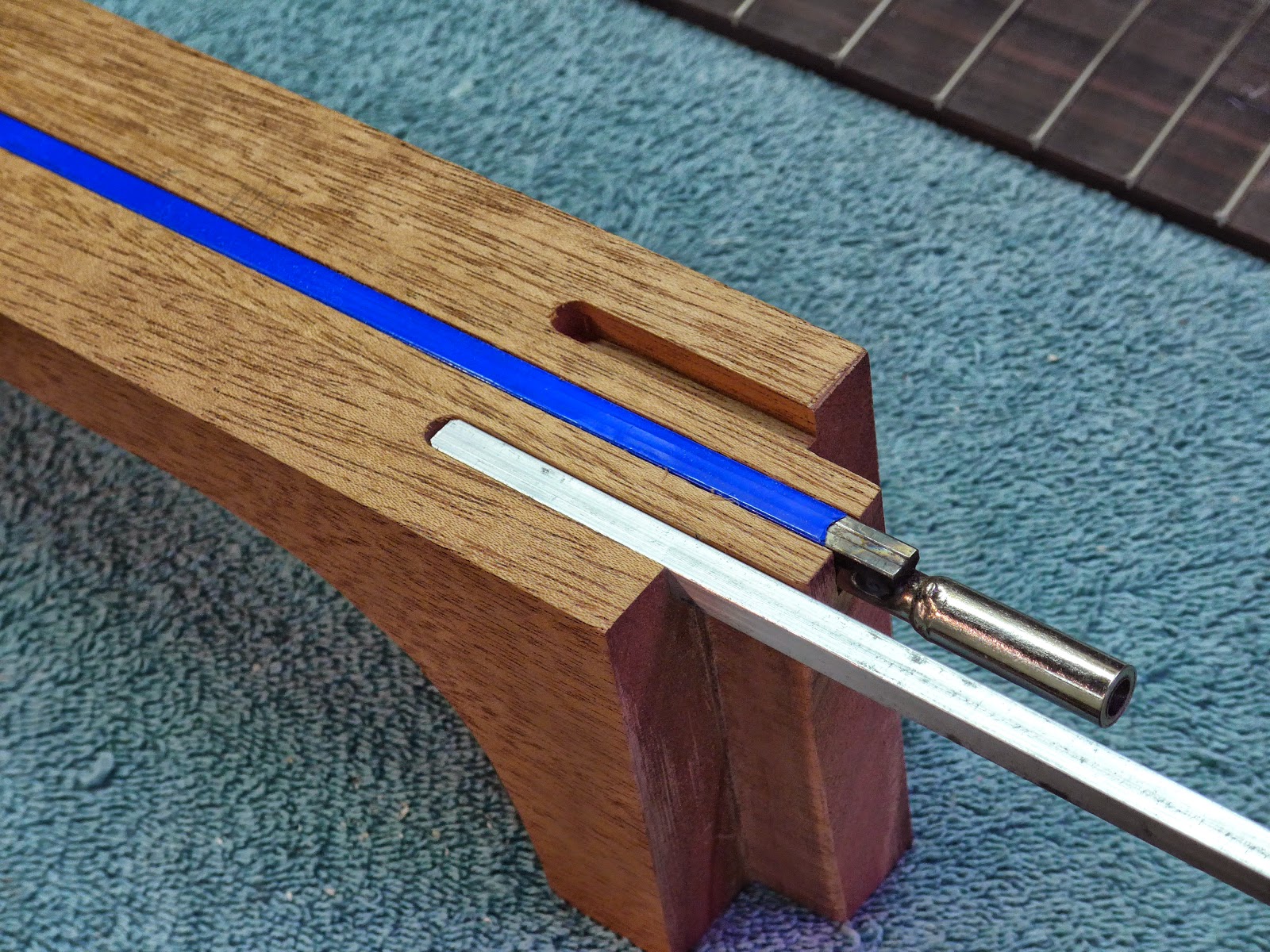
This is the heel of the neck, down at the end that hooks onto the body of the guitar. That blue thing running down the middle of the neck is the adjustable tension bar that helps keep the proper shape in the neck despite changes in temperature and humidity. The wood thing coming off the bottom of the neck is a tenon that will fit right into a slot of its size on the body of the guitar. That aluminum bar is one of Bruce's crucial refinements. When he is finished working it over, it will provide a remarkable stability on one of the crucial guitar weak points, the top where the neck fits in. Two of those aluminum struts will be screwed into the fingerboard to make the guitar end of it, the part that fits over the top of the guitar, rigid. It's not going anyplace, in other words.

Best of all, no glue to put it together. It is traumatic for all parties involved to have to remove the glued neck from a guitar. But you can't reset if (inevitable after many years of playing) without doing that and even with great caution, you can damage the guitar quite a bit prying the neck off.  That's because it's glued in a couple of different directions, not the least of which is to the top of the guitar.

Bruce's (and increasingly a lot of other makers) don't work that way.

The neck will be bolted on and as an extra little bit of stability, the fingerboard will be screwed to the ends of these aluminum braces.

I have always wondered how luthiers get their fingerboards to stay in place once they have spread glue all along the neck (and the fingerboard bottom). There is a tiny secret.

Centering the fingeboard

There is a tiny nail beneath the fingerboard to hold it exactly in place as the piece is being smooshed onto the neck. Bruce uses that nail to hold the top of the fingerboard in place as he aligns the bottom with the heel of the neck. Very dandy and leads to a perfectly placed fingerboard.

It takes lots of clamps to hold this down to dry, because this glue joint is one of the most important in the guitar. It must resist all those tensions, never shift, never break away from the neck and stay flatly in place, no matter what. 

Clamped and drying
Everything is going to sit for about a week now. Then we'll gather for some of the final touches. Bruce will put the neck on, the tuners and locate the perfect spot for the bridge (where the strings hook on). We'll also look at some final finish points that will make this my guitar, no questions asked.

Please come back.


Wednesday, June 25, 2014

Some Trouble on the Build My Guitar Front!

Build My Guitar

So here it hangs in all its glory, my guitar with a single coat of gun oil, the first of a bunch, to bring out its fabulous figuring. I would be lying were I to say I am calm about this, but it doesn't pay to get too excited, a point on which I got an important lesson on Tuesday, when I went to see Bruce Roper at his luthier's shop off Lincoln Avenue and got an unhappy surprise.

If you were living in a bubble you might not have had any trouble with humidity these past two weeks. I do not. In Pennsylvania, it was so humid it was impossible to breath even in the woods. Apparently, the same problem was at work here in Chicago. You can't see it and I'm not going to show it because it may be a problem that will solve itself, but the back of this spectacular guitar now looks a little like the surface of Lake Michigan. Wavy in a bad way. I can explain how that happened, but I am also convinced the problem will solve itself over the next couple of years. (Owning great guitars is a long-term proposition.)

How it happens.

Wood is porous, and depending on the type, some is more porous than others. That is why people who build instruments pay a lot of attention to relative humidity and the levels of humidity in the wood they are shaping. Guitars like it in the 50 to 55 percent humidity range. Bad things start to happen when humidity drops below that number, and other kinds of bad things happen when it gets above it.

Drop too far into the dry zone and the wood shrinks somewhat dramatically, sometimes cracking surfaces or pulling them away from braces. Frets, the metal strips across the fingerboard that actually stop the string so it can vibrate and make its sound, seem to grow. In reality, this is one of those, "No, fool, the sun's not going down, the horizon is coming up" problems. If frets are sticking out, it means the fingerboard is shrinking from dryness.

Bob Taylor (That's right of that Taylor) wrote a recent article and included this picture of a fretboard that has shrunk from dryness.

Doesn't seem like much of a problem, does it. Try to play a guitar like that and it feels like someone is pushing tiny chisels into your hands. Again, the problem is the fingerboard shrinking, not the fret. You can fix this. But this is not my problem.

I can find no pictures of what happens when there is too much relative humidity. So I will explain it. Just as wood shrinks in dryness, it expands when it gets wet. Not much of a problem for a piece of wood just sitting there, but the back on a guitar is glued in place in so many different ways it's pointless to list them. It's a solid thing if its done well.

The problem is the solid thing has no where to go if humidity comes to visit. In most cases, this is not a problem. Guitars adjust themselves. But in some cases, when the humidity goes up far and fast, the instrument can't do anything but create bumps as the swelling wood strains against the glue points. A little of that is what happened  on the back of my guitar.

Bruce seems mortified. It's not that his shop is sopping wet. Mine is the only guitar that has had this problem over the past couple of weeks, and Bruce has lots of guitars at lots of stages in his shop. It was such a wonderful thing just a few weeks ago. Now it has some bumps. I doubt anyone will ever see them but me and I view them as a small crisis in what is a relatively long journey. There is probably an upside here in a couple of years. When I put this instrument in my house, which has air in the summer (We have done well!) and the right kind of heat in the winter, the bumps will most likely go away.

Too much time on bumps. On to the neck thing. That's right, the neck thing. We're building the neck now.

And I do mean building.


Measuring for the fingerboard and headstock


The bald neck with its tension rod
Cutting to size
This part of the job is a little like building a bridge (Yes, I know, there is a bridge, but that's later). Bruce's neck bolts on in two directions. No glue at all. That means it is easy to get off if you have to remove it for repairs. This is the design he has settled on after 20 years or so of struggling with necks glued into place with everything from old horse hide glues to epoxy. It's much easier, although less traditional, to just bolt them on in a way that works. Bruce's is a way that works. He will have horizontal bolts going into the block at the top of the guitar, and vertical bolts under the fingerboard.

But first, we had to get everything about the neck ready for the big glue up!

Putting the frets on the fingerboard was pretty interesting. The frets have a 16 inch curve to them, to match the 16 inch radius curve of the neck. Bruce uses a couple of tools to put them in place. On is a simple fret cutter. The second is a little gizmo he invented that gently rocks a 16 inch curve in the fret so it will fit well.

Rocking the curve into a fret
Then he puts the fret in place and taps it a bit with a fret hammer just to get it going. Then he uses a drill press with a special jig that also has a 16 inch radius curve to push the fret into the slot. The frets have little tangs to hold them in place, but Bruce uses glue, too.

It takes about an hour to get all the frets into the neck for my guitar. When it's completed, it looks like this:

Frets in place on a fingerboard
I'm thinking we are close to a finish on this guitar, and that is exciting for me. I can't wait to hear it. We tap it each time I visit. It sounds bright and clear. That could be very nice. But we won't know until it's finished. My guess would be mid-July.

Until that time, it's all happening right here at buildmyguitar.blogspot.com.

Tell your friends. Tell your inlaws. Tell your parents. And so on. See you later!